Cryptocurrency and Cannabis: The Perfect Match
November 24, 2023

There is no denying the fact that the cannabis industry is a behemoth. In 2023, worldwide legal cannabis sales are expected to rise 15% to $37 billion. This rise is primarily driven by an anticipated 14% gain in the US as a result of increased adoption.
The United States has already reaped the rewards of the Cannabis industry in 2022. As per
from the Urban Institute:
California, Washington, and Illinois had the highest total state tax revenue collected, with $774 million, $517 million, and $466 million, respectively.
Almost $3 billion in excise taxes collected.
Despite the cannabis industry’s billion-dollar revenues, it faces significant challenges with U.S. regulations. Being labeled as a “high-risk” industry has essentially barred it from accessing conventional financial systems.
In this article, we will show you how crypto payments could be the key to solving these payment headaches for the cannabis industry.
The dicey situation of the cannabis sector in the US
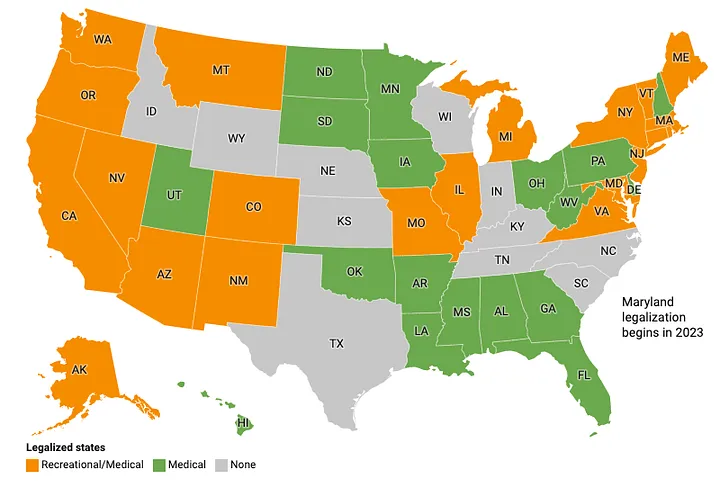
Despite being legal and a thriving business in 24 states (as of writing), cannabis remains illegal at the Federal level due to its classification as a Schedule I drug. Because of this regulatory grey zone, it becomes a significant barrier for regulated financial institutions, to engage with cannabis-related businesses (CRBs). As a result, CRBs are left with a narrow range of banking options, affecting their operations in several ways.
Top 5 payment problems faced by Cannabis businesses
#1 High risk and high fees
Because of its federal status, the cannabis sector is categorized as high-risk, resulting in higher fees and more stringent contract terms.What does this mean?A significant portion of the financial sector, including many major banks and financial institutions, steer clear of providing services to CRBs to avoid the administrative cost of monitoring and managing risks associated with high risk industries. Those that do, charge
(as much as $750-$2,500 or more per account per month), which price out smaller operators.On top of that, these financial processors might suddenly terminate their contracts with CRBs due to increased legal risk, added regulatory scrutiny or policy changes.
#2 Inability to obtain Loans
Businesses need to secure loans from financial institutions to satisfy operational cost management, for business growth and expansion. However, this often doesn’t work for CRBs since these financial institutions avoid lending to the cannabis industry due to the heightened scrutiny from regulatory bodies and the increased compliance obligations associated with managing CRBs.Some financial institutions may still issue loans to cannabis businesses. However, they may charge humongous fees to compensate for various risk management procedures they may need to undertake. For example, financial institutions may need to file certain regulatory reports for transactions involving CRBs.
#3 Alternative Financing Sources
Due to a lack of banking support, cannabis industry entrepreneurs often turn to alternative financing sources, such as angel investors, venture capital, and private equity funds. They may also issue funding from private loan issuers, albeit at higher interest rates.Securing funding from private investors also comes with its own set of issues. For example, a CRB might have to offer an investor a substantial ownership stake.
#4 Cash-only transactions
Many cannabis businesses have to rely solely on cash transactions because they lack access to banking services. With an estimated 70% of cannabis-related businesses operating exclusively with cash, the practice presents a host of challenges that extend far beyond mere inconvenience.Operating primarily with cash not only complicates transactions but also raises security risks. Cannabis dispensaries, which often handle large sums of cash, become targets for crime, leading to various serious incidents, including fatal shootings and violent robberies. Moreover, the need for increased insurance due to the higher theft risk is often unmet, as insurance companies are restricted by stringent financial regulations and may not provide the necessary coverage.This highlights the severe implications of a cash-only system. A secure payment method is not just a matter of convenience but also a necessity for safety.
#5 Compliance and reporting
Navigating the complex and constantly changing regulatory environment puts CRBs in a tricky situation. Maintaining compliance requires them to keep precise and thorough records, a task that grows more demanding in the absence of traditional financial services.The absence of these services hinders efficient financial management and complicates compliance efforts. As regulations continue to shift, CRBs are under constant pressure to adapt, ensuring that their operations remain within legal bounds while also trying to manage their finances in a less-than-ideal banking environment.
Cryptocurrency payments are the solution
Crypto payments can revolutionize the cannabis industry, addressing many of their financial challenges with innovative solutions.
No intermediaries
: Cryptocurrency payments don’t require a payment intermediary. If two parties own a crypto wallet, they may transact as and when they please. This means that CRBs and their consumers no longer depend on a third-party financial service provider.
No chargebacks
: Blockchain technology and cryptocurrency inherently counteract chargebacks through their immutable and verifiable transaction framework. Once validated and recorded on the blockchain, each payment becomes irreversible, eliminating the possibility of alteration or reversal by any party, including the sender or receiver.
Global reach
: Crypto transactions can be conducted globally, breaking down geographical barriers. This worldwide reach opens up international markets for cannabis businesses, extending their customer base far beyond local confines.
Tax Management:
Cryptocurrencies simplify the cumbersome process of tax calculation and adherence. The blockchain acts like an incorruptible digital ledger, ensuring transparent and immutable financial activity recording, which is crucial for regulatory compliance and extensive recordkeeping.
Privacy
: Cryptocurrencies address the privacy concerns of consumers while maintaining transparency in transactions. They provide an option for anonymity, a significant consideration for many cannabis purchasers. Users interact using their public addresses instead of their actual names.
How can I integrate cryptocurrency payments?
The adoption of cryptocurrency in the cannabis industry is not just a trend. It’s a strategic move to overcome many of its existing financial challenges.While the idea of integrating crypto payments into your business operations might seem daunting, EukaPay offers a seamless solution. EukaPay provides a comprehensive system, including a point-of-sale and invoicing platform, complemented by built-in accounting and analytics tools with real time reporting.
Discover more about how EukaPay can transform your cannabis business operations.
Visit EukaPay’s
today for more information and begin your path to financial innovation and stability in the ever-evolving world of cannabis commerce.
Products
Use Cases
© 2026 EukaPay. All rights reserved.
FINTRAC: M22233887